Skip to content

AI-assisted engineering · Expert-verified

Specialist simulation for pipelines, piping and subsea systems.

Finite element analysis and stress engineering, built fast with AI and verified by a specialist who can explain every result.

  • 10+years in piping stress and FEA
  • 19technical cases published
  • EN · ESdelivered in English and Spanish
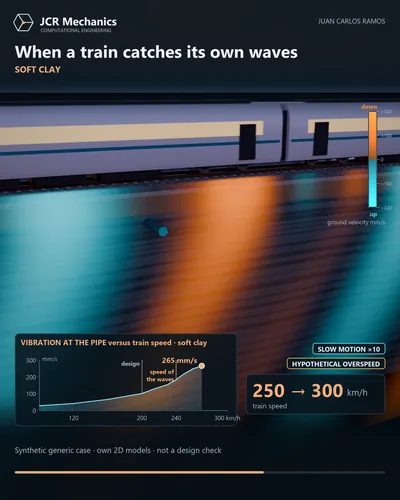
From the portfolioWhen a train catches its own wavesGround waves under a high-speed train reaching a buried pipeline. Synthetic case.

The idea

AI can build a model in an afternoon. Knowing whether it is right still takes an engineer.

AI tools now write the scripts, generate the meshes and post-process the results faster than any team could. What they cannot do is answer for the result. That part has not changed: someone has to know what the answer should look like before the model runs, notice when it is wrong, and explain it to the people who will act on it.

  • Speed from AI

    Scripted models, parametric studies and visual results in days instead of weeks.

  • Judgement from experience

    Set up, checked and interpreted by a specialist with a PhD in finite elements and more than ten years of project work.

  • Answers you can defend

    Every figure traced to its source, with the assumptions and limits stated in plain language.

Services

What we work on

Five lines of work, one way of doing them. Each engagement is scoped around the decision the analysis has to support, and framed against the applicable codes: ASME, API and DNV.

01

Subsea pipelines & flowlines

Global behaviour of a pipeline on the seabed, from installation to operation.

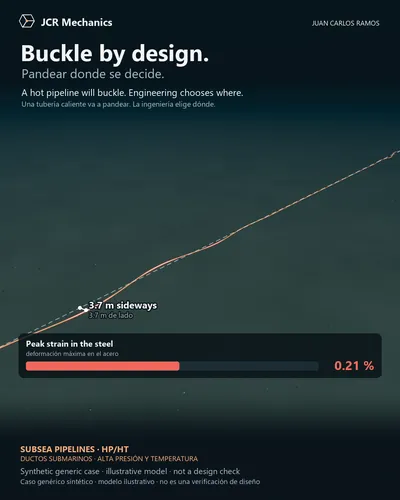
  • Lateral and upheaval buckling, with soil–pipe interaction
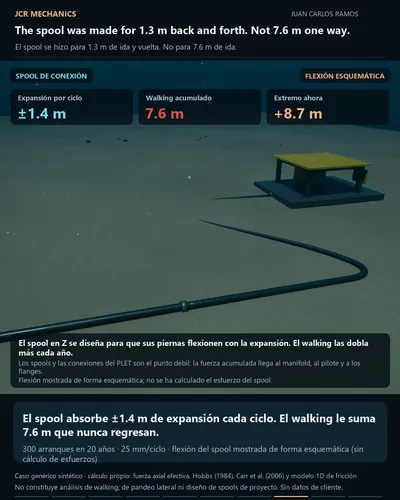
  • Pipeline walking and thermal expansion
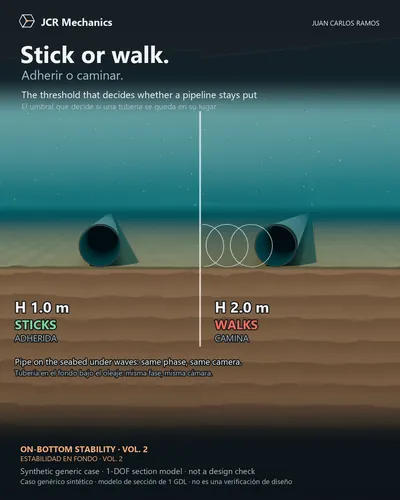
  • On-bottom stability and shore approaches
  • Free spans and fatigue
  • Installation and tie-in spools
Related work
02

Piping stress & plant systems

Flexibility, loads and dynamic behaviour of piping and the equipment it connects.

  • Static and dynamic stress and flexibility analysis
  • Flow- and acoustic-induced vibration (FIV/AIV)
  • Pipe supports and equipment nozzle loads
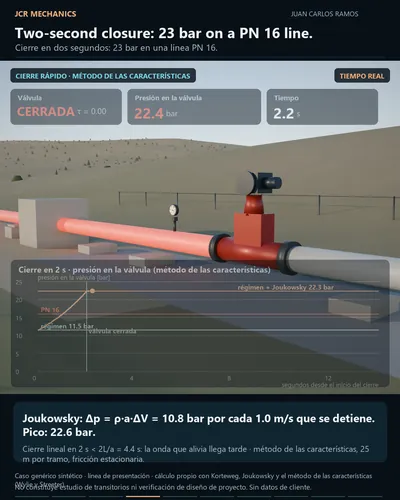
  • Water hammer and surge
  • Tanks, vessels and stacks: buckling, seismic, sloshing
Related work
03

Advanced finite element analysis

Non-linear models for the problems that hand formulas and code rules do not cover.

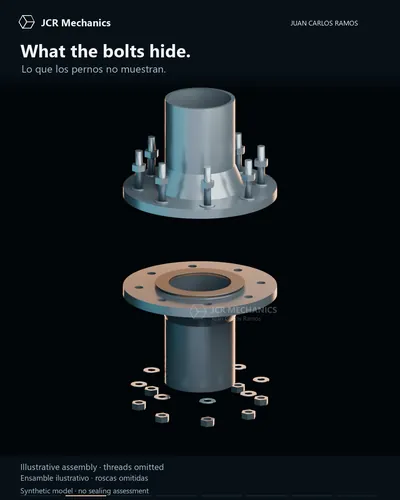
  • Bolted flange joints: preload, contact and sealing
  • Design by analysis and stress linearisation (ASME VIII-2)
  • Plasticity, large displacement and buckling
  • Thermal-structural coupling
  • Purpose-built solvers and scripts
Related work
04

Integrity & fitness for service

Whether a component with a flaw, or with a loading history, is still fit to operate.

  • Fatigue with S-N curves
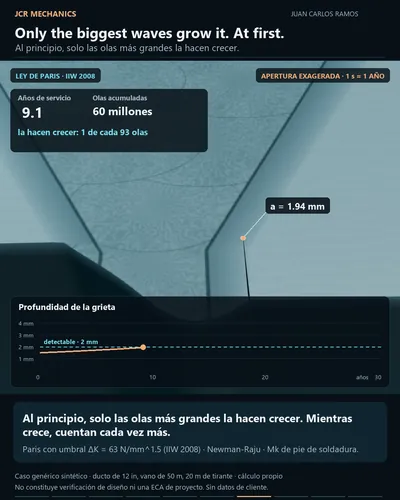
  • Fracture mechanics and crack growth
  • Failure assessment diagrams
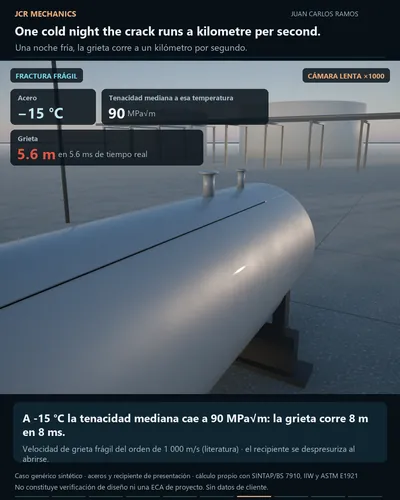
  • Brittle fracture at low temperature
Related work
05

Technical explainers

Engineering results turned into short animations that a board, a regulator or a client can follow.

  • Narrated and captioned video, in English and Spanish
  • Built from the model, not from stock footage
  • Every figure on screen traced to the analysis
Related work

Method

Fast where AI is good. Careful where it is not.

  1. Frame the question

    What decision depends on the analysis? Load cases, limits and acceptance criteria are agreed before any model exists.

  2. Build with AI, fast

    Models are scripted, parametric and reproducible. AI tools write and run them in hours, so more cases and sensitivities get explored.

  3. Verify like it matters

    Hand calculations, benchmark cases and sensitivity checks. Whatever the model says has to agree with physics a specialist can explain.

  4. Deliver results you can trace

    A report where every figure points to its source, the model files and, when it helps, an animation that makes the result clear to non-specialists.

About

An engineer first. AI as the power tool.

JCR Mechanics is the engineering practice of Juan Carlos Ramos, a mechanical engineer with a PhD in the finite element method and more than ten years in piping stress analysis and FEA for oil and gas.

He leads a piping stress discipline for onshore and offshore projects: static and dynamic stress analysis of pipelines and process piping, finite element models for complex integrity problems such as subsea upheaval buckling with soil–pipe interaction, flow- and acoustic-induced vibration in gas metering and filtration skids, and pipe supports with their structural interface, to ASME, API and DNV.

It starts from a simple observation: AI has made building a model fast, but it has not made the answer trustworthy. That still takes someone who has done the calculation by hand, has seen how these systems behave, and can stand in front of a client and explain why the result is what it is.

Every piece in the portfolio was produced that way: scripted and built with AI tools, with every figure traced to its source and independently reviewed before it was published.
Contact

Need this level of analysis on your project?

Send the question, whatever drawings and data you can share, and your deadline. You will get back a proposed scope, method and timeline.

Confidential by default: project data is never used in public material.